| p.3 | |
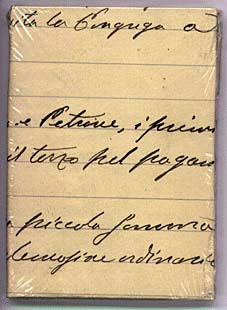 |
Do you know what it is shown in the left
picture? This is a kind of notebook. But you might wonder why letters
are written on its outer cover by hand, and why it is not printed even
if it is a kind of design. This notebook is related to the flood covered Firenze in the autumn of 1966. In November cyclone attacked Italy, which brought flood of the Arno River on 4th of November. Flood water covered the city of Firenze as deep as bridges over the Arno River were sunk into muddy water. At that time not only beautiful artworks but also many historical hand written documents suffered water hazard. Most of them were considered not to be able to be repaired, and there was no way other than to be discarded. However the head of Giannini, Enrico, took great efforts to recover and utilize them. Thus those documents get a new life nowadays in beautiful stationery goods like this notebook. |
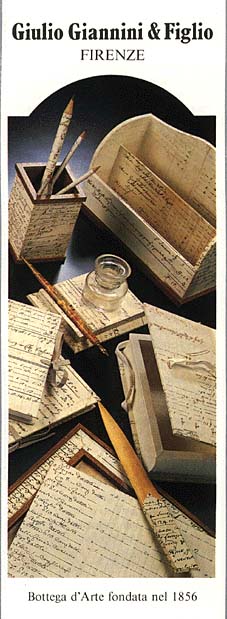 |
Here I will introduce to you the explanation
written on the leaflet of Giannini. "In 1966 Florence was submerged by the raging floodwaters of the Arno River. Water, mud and debris covered the city resulting in tragedy for Florence and the entire world. Along with the many artworks and historical relics that were irreparably damaged or lost, hundreds of handwritten records from farms, parishes, monasteries, etc. were reduced to illegible volumes with stained, sodden pages. The Giannini family could not accept the fact that so much precious material could be thrown away. With the great love of books that distinguished them through the generations they began to salvage those pages which had not been too severely damaged. Afterwards, fascinated by the splendid calligraphy on those sheets, they had the idea of using them to cover items of their own manufacture. It was thus that manuscripts became something more than archive materials, and were transformed into artistic, decorative elements. The Bottega d'Arte Giulio Giannini & Figlio guarantees that the items of its production are covered in authentic manuscripts dating from the XVII, XVIII and XIX centuries." These explanations are written on the leaflet with four languages, Italian, French, German and English. As far as it is possible, damaged documents were repaired. It was regrettable to discard unrepairable documents, and they were utilized for stationery goods to get a new life. Old handwritten manuscripts on these goods are impressive and beautiful, which also shows us the efforts of Giannini family to share the value of old calligraphy with world people. |
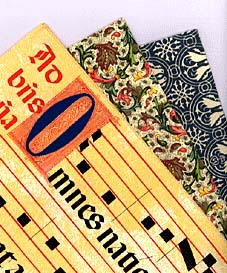
| In the shop, decorated papers such as shown
in the right picture are sold. On the left paper unique music score is printed,
which recalls Renaissance culture. In the middle paper golden part of the
artwork is likely to be printed with gold dust when viewed with a magnifying
glass. As I asked a professional designer back in Japan. The method of printing
is different from usual way adopted in Japan. This is mainly because production
cost is forced to be low in Japan. As for the right paper some slight gaps
are found on the printed pattern. These will be treated in Japan as failure.
But as I touched and watched, I felt these Italian quality of printing as
a kind of deformation for beautiful paintings. In Japan the standard of industrial production and the economic framework govern the quality of papers. However, far from monotonous Japanese way of production, Italian way is much tasty and expressive for us. |
 |
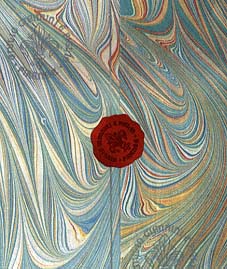
| The right picture is not showing a Giannini
commercial product but a wrapping paper. This is a mass produced paper,
and the rank of paper is inferior comparing artpapers shown above. However,
the taste of this wrapping paper is also nice, and I thought it can be usable
for interior decoration. |
 |
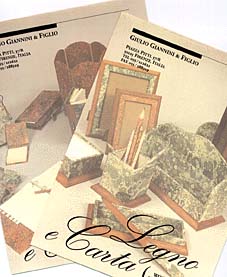 |
In the left picture some of Giannini's catalogs
are shown. Many stationery goods such as utilizing marbled paper appear
on these leaflets. In Giannini's shop these stationeries are displayed everywhere.
So standing in the shop, it is as like many beautiful marble stones are
placed. As for marble stone, it is used for another traditional handicraft
"mosaic" in Firenze. In this environment marbled paper is invented
and brought up. |
| go to p.4 | |