p.2


Mr. Mannina kindly explained
his work and his shop for us.
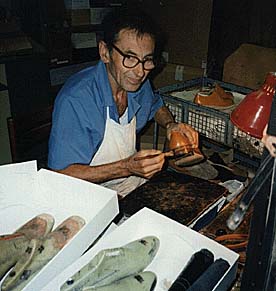
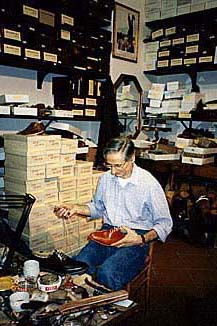
Master Mannina came in, and my impression was that he is exactly a nice craftsman as written in the book. After we said greetings, "Piacere" in Italian, he guided us to his workshop in the inner part of the store. Walking after him, passing through corridor, we came to another side of the building. There were workshops aking shoes by handicraft. Three raftsmen were working silently, engaged with each tasks of making shoes. A side of theroom facing the road was a show window. Other part of the room was used for making shoes. There were so many boxes for shoes stacked near the walls.
Mr. Mannina frankly explained us how the shoes were made by hand. And he demonstrated sewing shoes as shown in the left photograph.
Then Mr. Mannina said to us, "Why don't you take a cup of coffee?" and brought us to a bar near the shop. And it surprised me that he treated us as like friends of him although we met him for the first time. What a "simpatico", friendly, gentleman he is! We became completely fans of Mr. Mannina.

It's the best, made by hand.
(click here for movie: 3MB)
In the front part of the left photograph, you can see molds of shoes, prepared for each cutomers. The craftsman in the photograph was painting vanish or something. There are no waste time in their workmanship, otherwise the price of the handmade shoes will be too expensive for common folks to buy.
"......It is a nice thing for craftsmen to make shoes easy to wear, for neighbors. ......", he said to Mr. Matsuyama, the author of the book explaining craftsmen in Firenze.

Mr. Mannina is producing many shoes
with several craftsmen.

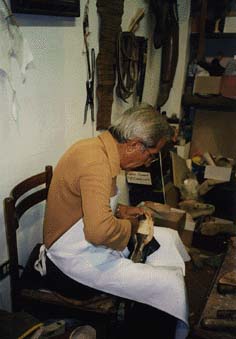
This craftsman was nailing leather with wooden hammer. The sounds of nailing was comfortable to my ears. His work was so smooth indicating his matured skill.
On the wooden working desk, there were wooden hammers, pliers, and other tools.
Handmade shoes are manufactured through several tasks. The craftsmen seated were able to do his tasks just extending his arms to get tools. I think one of traditional industrial arts suitable for handicraft is manufacturing shoes.

p.3 (next page)